30-Day Declutter Challenge: One Small Task a Day for a Calmer Home
A 30-day declutter challenge works because it asks very little of you each day. You don’t need a free weekend, a storage unit, or a burst of motivation. You need about fifteen minutes and one small task. Do that for a month and your home feels lighter without the exhausting “pull everything out” day that most people dread.
This guide gives you the full 30-day plan, week by week, plus simple rules that help you actually finish. If your whole house already feels like too much, start with The 7-Day Home Reset first, then come back here for the deeper clear-out.
How the 30-Day Declutter Challenge Works
Each day has one small area or one category of things. You set a timer for 15 minutes, work only on that task, and stop when the timer ends, even if you’re not finished. Stopping on time is what keeps the challenge going for 30 days instead of three.
Before Day 1, set up four bags or boxes and keep them in one spot:
- Trash – broken, expired, stained beyond saving.
- Donate – good condition, just not used by you.
- Return – belongs to someone else or another room.
- Maybe – you can’t decide yet. Seal it, write the date, and revisit it on Day 30.
One rule matters more than the rest: the donate bag leaves the house every Sunday. If it sits in the hallway, the clutter has only moved, not left.
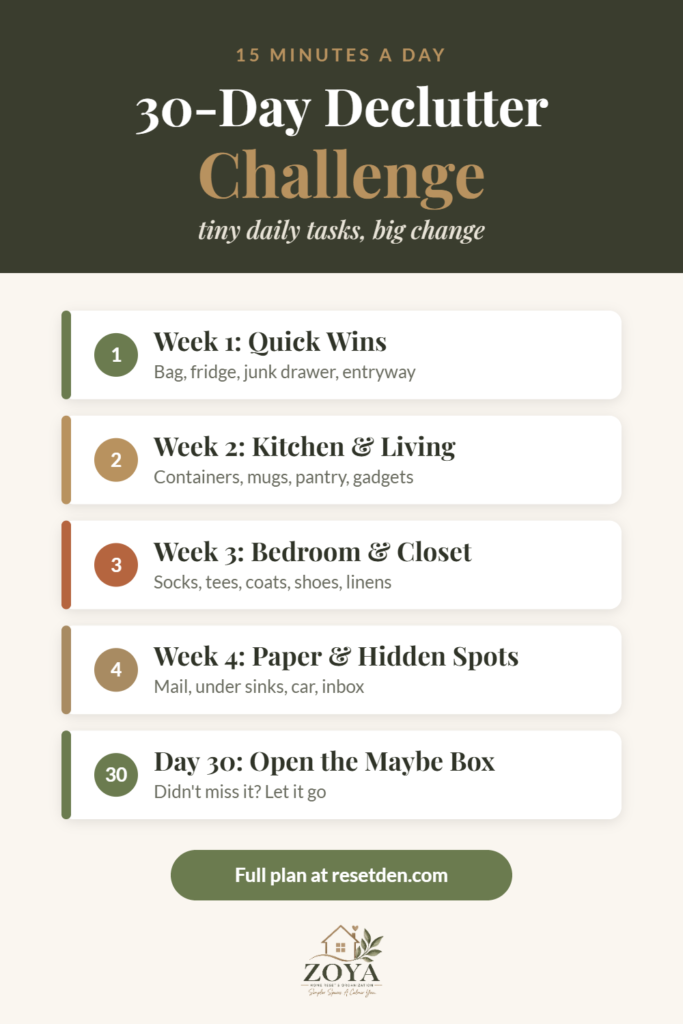
Week 1: Quick Wins (Days 1–7)
The first week is about easy decisions. These spots fill up with obvious trash and duplicates, so you see progress fast and build the habit.
- Day 1 – Your bag or purse. Receipts, wrappers, dried-out pens.
- Day 2 – The fridge. Expired sauces, leftovers past their day, empty jars.
- Day 3 – The bathroom counter. Keep only what you use every day out.
- Day 4 – The junk drawer. Dead batteries, mystery keys, takeout menus.
- Day 5 – Your phone’s photos and downloads. Screenshots and duplicates count as clutter too.
- Day 6 – The entryway. Shoes nobody wears, flyers, extra tote bags.
- Day 7 – Rest and drop off. Take the donate bag out and empty the trash bag.
Week 2: The Kitchen and Living Spaces (Days 8–14)
Now you move into rooms the whole household uses. Work on one shelf or one cabinet a day, not the whole room.
- Day 8 – Food storage containers. Keep only the ones with matching lids.
- Day 9 – Mugs and cups. Count how many you actually use in a week.
- Day 10 – The pantry. Check dates and group what’s left (our pantry organization guide helps here).
- Day 11 – Kitchen gadgets. If it hasn’t been used in a year, it can go.
- Day 12 – The coffee table and TV stand. Old remotes, cables, magazines.
- Day 13 – Books and DVDs. Keep favorites and the ones you’ll truly reread.
- Day 14 – Rest and drop off.
Week 3: Bedroom and Closet (Days 15–21)
Clothes take more emotional energy, so this week is split into small categories. Pull out one type of item at a time and decide on each piece while you hold it.
- Day 15 – Socks and underwear. Holes and lonely socks go first.
- Day 16 – T-shirts. Faded, stretched, or never worn.
- Day 17 – Jackets and coats. One or two per season is usually enough.
- Day 18 – Shoes. Painful pairs don’t get worn, however nice they look.
- Day 19 – Bedside table. Chargers, old notebooks, half-read books.
- Day 20 – Linens and towels. Two sets per bed and two towels per person is a good start.
- Day 21 – Rest and drop off.
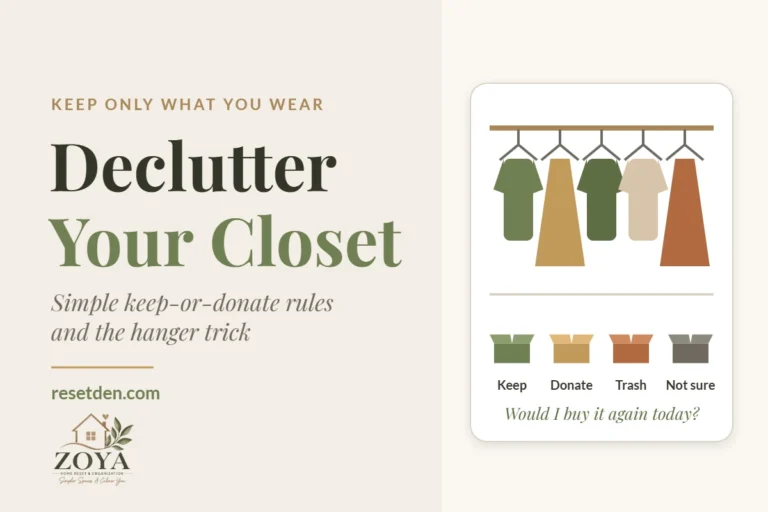
For a full wardrobe clear-out, see how to declutter your closet, then make the space work with our small closet organization ideas.
Week 4: Paper, Storage and Hidden Spots (Days 22–30)
The last stretch covers the places you don’t see every day. By now the habit is strong, so these harder areas feel manageable.
- Day 22 – Mail and paper pile. Shred, file, or act. Nothing goes back on the pile.
- Day 23 – Under the bathroom sink. Old products and empty bottles.
- Day 24 – Under the kitchen sink. Duplicate cleaners and worn sponges.
- Day 25 – Toys or hobby supplies. Keep what is used now, not “someday”.
- Day 26 – Bags and suitcases. Store small bags inside big ones.
- Day 27 – The car. Trash, receipts, and things that belong inside the house.
- Day 28 – Digital: email inbox. Unsubscribe from five lists.
- Day 29 – The “one hard spot”. The closet or corner you’ve avoided all month.
- Day 30 – Open the Maybe box. If you didn’t miss it for a month, let it go.
Tips to Finish the 30-Day Declutter Challenge
- Missed a day? Skip it, don’t double up. Doing two tasks to “catch up” is how challenges end. Just continue with today’s task.
- Same time every day. Attach the task to something you already do, like after the morning coffee or before the evening news.
- Take a before photo. On tired days, looking at how far you’ve come is often enough to start.
- Don’t buy containers yet. Organize what’s left after the 30 days, not before. Most people need fewer bins than they think.
- Use a printed list. Ticking a box every day is surprisingly motivating. Our room-by-room declutter checklist pairs well with this plan.
If you’d like a calm, guided structure for the week after the challenge, the ZOYA 7-Day Calm Home Reset Planner walks you through one room a day with printable pages, so the space you just cleared stays that way.
Your 30-Day Declutter Challenge Tracker
Copy this simple tracker onto a sheet of paper and hang it on the fridge. Draw a box for each day and tick it when the 15 minutes are done.
| Week | Focus | Drop-off day | Checkpoint at the end of the week |
|---|---|---|---|
| Week 1 (Days 1 to 7) | Quick wins: bag, fridge, bathroom, junk drawer, phone, entryway | Day 7 | First donate bag is out of the house |
| Week 2 (Days 8 to 14) | Kitchen and living spaces | Day 14 | Counters and the coffee table stay clear for a whole day |
| Week 3 (Days 15 to 21) | Bedroom and closet, one category a day | Day 21 | Closet doors close easily |
| Week 4 (Days 22 to 30) | Paper, storage and hidden spots | Day 30 | The Maybe box is opened and decided |
How to Handle Sentimental Items During the Challenge
Old letters, children’s drawings and gifts from people you love are the hardest things to sort. If you start with them, the challenge often stops on Day 3. These rules keep them from derailing your month:
- Set them aside, don’t decide. When you find a sentimental item during a daily task, put it in one “memories” box and keep going.
- Give memories a limit, not a deadline. One box per person is a good size. What fits in the box stays, and you choose the best pieces.
- Photograph what you can’t keep. A photo of a large school project keeps the memory without the shelf space.
- Keep the best one. One favorite mug from a set, one of your grandmother’s scarves, one baby outfit. The single piece often means more than the whole pile.
- Leave it for Day 29. By then your decision muscle is much stronger, and the memories box becomes your “one hard spot”.
What to Do on Day 31
The challenge ends, but the habits you built are what keep the space clear. Pick two or three of these and make them part of your normal week:
- One in, one out. When a new shirt, mug or toy comes home, one similar item leaves.
- A permanent donate bag. Keep one bag at the back of a closet and drop items in as you find them. Take it out when it is full.
- Five minutes on Sunday. Pick one drawer and give it a quick pass while the coffee brews.
- Repeat Week 1 each season. The quick wins fill up again over a few months. Seven short days bring them back to calm.
When you are ready to organize what is left, start with the room you use most. Our kitchen declutter guide is a good next step.
🌿 Not sure where to start?
Get the free 60-Minute Calm Home Reset Checklist: six simple steps with times, plus a 20-minute version for busy days.
Get the free checklist →FAQ
How long should each day of a 30-day declutter challenge take?
About 15 minutes. Short sessions make it easy to keep going every day. If you have more energy, you can continue, but stopping on time is what helps you finish all 30 days.
What if I miss a few days?
Just pick up with today’s task. Skipped days can be added at the end or left out. The goal is a lighter home, not a perfect record.
Can I do the challenge with kids or a partner?
Yes. Give each person their own small task on the same day, like one drawer each, and decide only on your own things. Let others choose what happens to theirs.
Start Small, Finish Strong
Thirty small tasks add up to a home that feels noticeably calmer. Start with Day 1 today: your bag, fifteen minutes, nothing more. Tomorrow will be easier because you already started. Need ideas for what to let go of? See our list of 50 things to declutter right now.